
Thursday, 8 February 2018
How Bad Do You Want It? (Success) HD
This video has over 42 million views. Think you should watch it too?

7 Personality Traits of a Great Leader

If you want to be a great leader who attracts quality people, the key is to become a person of quality yourself. Leadership is the ability to attract someone to the gifts, skills and opportunities you offer as an owner, as a manager, as a parent. Leadership is the great challenge of life.
1. Learn to be strong but not impolite.
It is an extra step you must take to become a powerful, capable leader with a wide range of reach. Some people mistake rudeness for strength. It’s not even a good substitute.2. Learn to be kind but not weak.
We must not mistake weakness for kindness. Kindness isn’t weak. Kindness is a certain type of strength. We must be kind enough to tell someone the truth. We must be kind enough and considerate enough to lay it on the line. We must be kind enough to tell it like it is and not deal in delusion.3. Learn to be bold but not a bully.
It takes boldness to win the day. To build your influence, you’ve got to walk in front of your group. You’ve got to be willing to take the first arrow, tackle the first problem, discover the first sign of trouble. Like the farmer, if you want any rewards at harvest time, you have got to be bold and face the weeds and the rain and the bugs straight on. You’ve got to seize the moment.4. Learn to be humble but not timid.
You can’t get to the high life by being timid. Some people mistake timidity for humility. But humility is a virtue; timidity is a disease. It’s an affliction. It can be cured, but it is a problem. Humility is almost a God-like word—a sense of awe, a sense of wonder, an awareness of the human soul and spirit, an understanding that there is something unique about the human drama versus the rest of life. Humility is a grasp of the distance between us and the stars, yet having the feeling that we’re part of the stars.5. Learn to be proud but not arrogant.
It takes pride to build your ambitions. It takes pride in your community. It takes pride in a cause, in accomplishment. But the key to becoming a good leader is to be proud without being arrogant. Do you know the worst kind of arrogance? Arrogance from ignorance. It’s intolerable. If someone is smart and arrogant, we can tolerate that. But if someone is ignorant and arrogant, that’s just too much to take.6. Learn to develop humor without folly.
In leadership, we learn that it’s OK to be witty but not silly; fun but not foolish.7. Learn to deal in realities.
Deal in truth. Save yourself the agony of delusion. Just accept life as it is—the whole drama of life. It’s fascinating.Life is unique. Leadership is unique. The skills that work well for one leader may not work at all for another. However, the fundamental skills of leadership can be adopted to work well for just about everyone: at work, in the community and at home.
Source
Wednesday, 7 February 2018
How To Be a Better Person Using These 11 Simple Steps

Do you recognize this scenario? You find yourself reacting or handling changes in a way that feels less than graceful. You begin feeling down and wondering why you can’t seem to do better. Most of us have been there. Don’t worry; there’s always a way to improve. If you want to be a better person the phrase is “out with the old and in with the new.”
To help you get started, here’s a list of 11 things that will help you on your road to self-improvement.
Review Your Strengths.
Know What Needs Improvement
Work on One Thing at a Time
Positive Affirmations
Meditate
Find a Physical Activity That You Enjoy
Don’t be Afraid of Change
Honor Your Friends and Family
Listen to Your Parents and Grandparents
Believe in Yourself
Try Writing in Journal
Are you ready to take these steps to improve yourself and your life? It may not always be easy to change long-ingrained habits, but it’s probably not as difficult as you think either. None of us are perfect. We are all on a never ending journey of self improvement and self-realization. If you make an honest effort each day to change the things that you don’t like about yourself and strengthen your positive traits, you will start to realize that you are more wonderful than you could have ever imagined. You can enrich not only your own life, but also all of the lives you touch around you.
Source
Tuesday, 6 February 2018
Monday, 5 February 2018
The Qualities of Enterprising People

An enterprising person is one who comes across a pile of scrap metal and sees the making of a wonderful sculpture. An enterprising person is one who drives through an old decrepit part of town and sees a new housing development. An enterprising person is one who sees opportunity in all areas of life.
To be enterprising is to keep your eyes open and your mind active. To be skilled enough, confident enough, creative enough and disciplined enough to seize opportunities when they present themselves. A person with an enterprising attitude says, “Find out what you can do before taking action.” Do your homework. Do the research. Be prepared. Be resourceful. Do all you can in preparation of what’s to come.
You need two things to be enterprising:
1. Creativity—to see what’s out there and to shape it to your advantage. You need creativity to look at the world a little differently. You need creativity to take a different approach—to be different.
2. Courage—to be creative. You need courage to see things differently, courage to go against the crowd, courage to take a different approach, courage to stand alone if you have to, courage to choose activity over inactivity.
Being enterprising doesn’t just relate to the ability to make money. Being enterprising also means feeling good enough about yourself, having enough self-worth to seek advantages and opportunities that will make a difference in your future. By doing so, you will increase your confidence, your courage, your creativity and your self-worth–your enterprising nature.
Source
Getting things done

How do you get things done?
When are you most productive?
What things are you getting done?
If we want to move the needle in our life, we need to get the right things done, at the right time, in the right way.
Here is what it looks like for me.
First, I determine the #1 thing I can get done for the day that also moves me closer to my big goals.
This is the right thing. Second, I block my time first thing in the morning before the rest of the world is awake. This is the right time.
Third, I invest time filling myself up with God's Word and prayer right before I focus and work on the right thing. This is the right way.
What works for you?
Tips:
Pick your most productive time of the day.
Shut out all distractions - phone, text, email, social media, interruptions.
Invest the first part of the time filling yourself up. Then, work on your #1 priority that moves you closer to your big goal.
Do it EVERY DAY.
Two questions for you:
Do you think this strategy will work?
Do you have big goals and dreams?
You know what to do!
Keep me posted.
You are Born To Win, so go ahead and Live To Win!
Source

Sunday, 4 February 2018
Saturday, 3 February 2018
How to invest in an inflationary economy
A true look at recent inflation and what it means for you
After the last financial crisis, the US government began a program of quantitative easing (QE), aka printing money.
As a refresher, QE is when the Fed bolsters its balance sheet by buying treasuries to keep interest rates low. It’s like if you or I printing dollars to pay off our credit cards.
At the time, I wrote about the dangers of inflation this would cause. Almost everyone expected that the inflation we would see would be consumer inflation, i.e., when the price of goods goes up, sometimes rapidly. After all, you can’t pump dollars into the economy through artificially low interest rates without those dollars flowing into goods and raising prices. It’s pretty simple economics.
The official inflation stance
Yet, according to the official measurements of inflation, there hasn’t been much consumer inflation. As you can see from this chart by Statistica, it’s actually historically lower.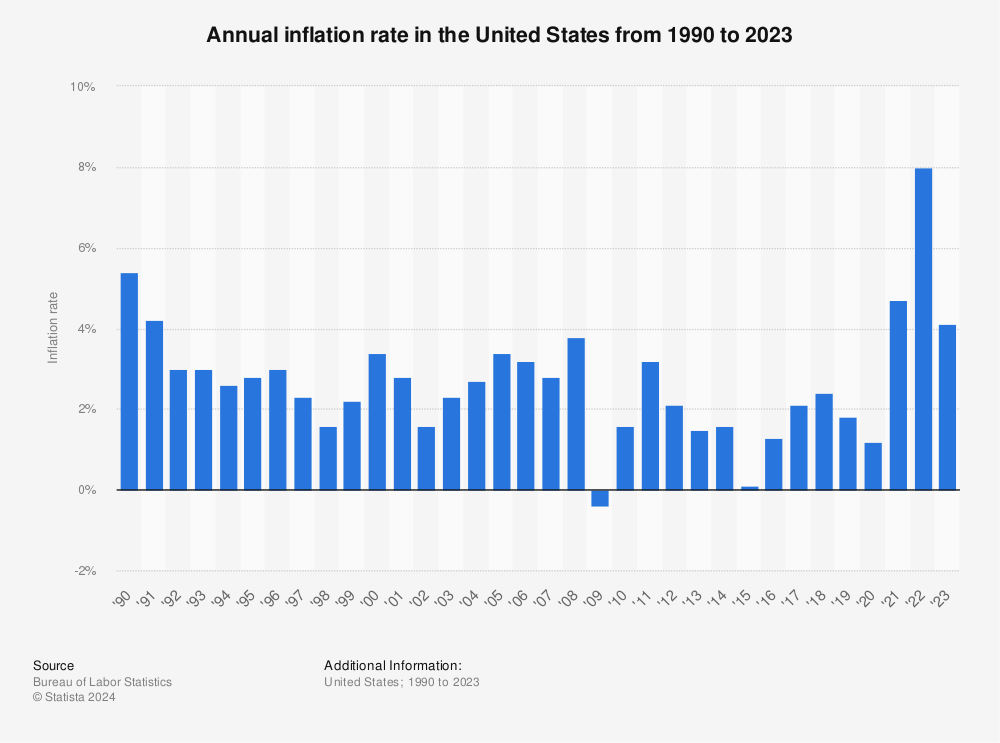
How could this be?
The first thing to explain this is that inflation is happening, but it’s not most readily apparent because of the way the US government measures inflation. As the old saying goes, “There are three kinds of lies: lies, damn lies, and statistics.” What does this mean? Simply that governments can use statistics to tell any story they want by manipulating the numbers. In this case, since 1990, it’s been clear that the government wants to tell the story that inflation is low.
A different look at inflation
Traditionally, inflation was measured by a fixed basket of goods period after period. This basket of goods was an agreed upon basket of what it would take to have a good standard of living.But as shadowstats.com writes, that formula was changed in 1990 to match a popular academic concept called “constant level of satisfaction,” as a “true cost of living concept.”
The general argument was that changing relative costs
of goods would result in consumer substitution of less-expensive goods
for more-expensive goods. Allowing for a substitution of goods within
the formerly fixed-basket, the maximization of the “utility” of money
held by consumers would allow attainment of “constant level of
satisfaction” for the consumer. This type of inflation-measure is more
appropriate for the GDP concept—where it is used today—measuring
shifting weightings with actual consumption, rather than with the fixed
weightings needed to assess the costs of maintaining a constant standard
of living
Why would they do this? Shadowstats.com gets into the details, but basically it was a way for the government to save money by, for instance, not having to increase Social Security payouts to match true inflation.
Matching the 1980 measurement method against the 1990 method, it’s easy to see why.
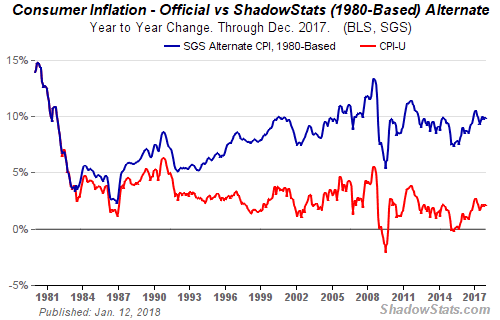
Looking at this chart, you can see that inflation over the last couple years has been hovering around 10%, among the highest it’s been since the 1980s, when the calculation was changed. Of course you don’t really need to be told this. Almost everyone I know feels the fact that prices have gone up for pretty basic things.
But outside of the argument of how to calculate inflation, there is another indicator that this flow of cash from QE had resulted in significant inflation, and that is asset inflation.
Measuring inflation by asset prices
As Bloomberg reports, “Quantitative easing, which saw major central banks buying government bonds outright and quadrupling their balance sheets since 2008 to $15 trillion, has boosted asset prices across the board.”Writer Jean-Michael Paul continues, “From 2008 to 2015, the nominal value of the global stock of investable assets has increased by about 40 percent, to over $500 trillion from over $350 trillion. Yet the real assets behind these numbers changed little, reflecting, in effect, the asset-inflationary nature of quantitative easing.”
Because assets are not tracked in a basket of goods, it becomes easy to look at them objectively and see their inflationary results, especially when compared to things like earnings.
In this case, the stock market has skyrocketed but there has not been performance behind the companies represented on the stock market to justify the rapid and record growth. Currently the price to value ratio for stocks is about 60% higher than average. But there are plenty of people who want to use statistics to suppress that too.
What high inflation means for you
Establishing that inflation is high, the question becomes, what does it mean for you and what should you do about it?First, it’s important to understand that inflation can make you poorer. For instance, employees are hurt by inflation because they can only sell their time, and time generally does not hedge against inflation well. Raises, if they come at all, generally come on an annual basis after inflation—not with it. And when inflation is underreported, raises hardly come at all.
Additionally, people who are deep in credit card debt or who have interest ARM loans are hurt by inflation because the Fed generally raises interest rates to combat inflation. Much bad debt is based on adjustable interest rates that go up during times of inflation, making debt payments more expensive. Some of you are probably experiencing this right now.
Finally, people who play by the old rules of money are hurt by inflation because they believe it is wise and prudent to save money in the bank. But the bank is smart, not dumb. And the bank plays by the new rules of money. They pay interest on money that doesn’t keep up with inflation. Money loses purchasing power as the bank uses your money to make more money.
Using inflation to get richer
The good news is that inflation doesn’t have to make you poorer. In fact, you can use it to get richer. I use a very simple formula to get richer from inflation: leverage and hedging.I play the bank’s game. I borrow money from the bank at a fixed rate, buy a cash flowing asset that covers the debt payment, and using less of my own money increases my return on investment.
In an inflationary economy, if the debt payment is fixed, it becomes less of a cost as the dollar loses purchasing power and my investments and income grow.
The reason my investments and income grow is because I purchase assets that hedge against inflation. For instance, in inflationary economies, rents generally rise. When I purchase investment property, the debt payment stays the same while my rents rise due to inflation. This creates more cash flow. I owe the bank only the agreed payment. The rising costs for rent flow straight into my pocket.
The same thing happens for businesses. As the cost of goods rise for consumers, businesses can adjust their pricing and benefit from inflation.
This works because business owners and investors aren’t selling time. They’re selling product that hedges against inflation. They are in control. Employees aren’t in control of their product—time—nor are they in control of their money (the bank or mutual fund is).
One other thing I do to hedge against inflation is invest in commodities. Generally that has been oil, gold, and silver. These are great investments when there is inflation. They’re not great when there’s deflation.
Therefore, while I believe they are good investments for me, they’re not good investments for everyone—especially people who are still learning about the economy and investing who may not be able to react quickly to changing economic conditions.
At the end of the day, what I’ve been preaching all along—invest for cash flow—is the safest and soundest strategy that will serve you well in an inflationary economy. It’s a sure way to grow richer.
Source
Friday, 2 February 2018
15 Unexpected Things You Should be Thankful For in Life

We all have our ups and downs in our life. Sometimes it is hard to see the positive. Sometimes you feel overwhelmed and your problems seem endless and unsolvable. The easiest thing is to just admit defeat and accept your current state of down as a permanent reality. However, you should always look at the bright side and positives even when everything seems dark and gloom. There is an educational experience in everything and it all depends on your attitude and mindset. Here are 15 unexpected things to be grateful in life:
Enemies:
Fewer people in your life:
Bad relationships:
Sudden breakups:
Failure:

Sadness:
Die hard 1:
Being let go from a bad job:
Delay:
Missed opportunities:

When they are out of your favorite donuts at the bakery:
First job after college:
Diet:
Tech malfunctioning:
This very moment:
Source
Thursday, 1 February 2018
How to Overcome Frustration: 3 Simple but Effective Steps

Frustration. It winds you up and can take so much out of you.
Because it not only sucks energy but also distracts you and can steal quite a bit of time.
So what can you do?
Well, sometimes that frustration can actually be a positive and can give you a new idea or angle on things. Or it can give you the power to keep going just a little bit more until you reach your goal.
But when you start going in circles, when the frustration just makes you mad or your mind foggy and the day is starting to slip through your fingers then there are steps you can take.
There are ways to turn such a state of mind or day around.
Into something better. Into something more helpful. And into something that will make you feel better again.
Step 1: Be here now.
When you are frustrated then you are often somewhere in the future in your mind. Somewhere you wish you would be. Or you are reliving a stumble or failure from your past.
Snap out of those headspaces and calm down by focusing your mind and attention on what is now, right here at this moment.
You can do so by for example:
- Focusing on your breathing. Sit down, close your eyes and just focus on the air going and out of your nose for 1-2 minutes. Take calm and slightly deeper breaths than usual and breathe with your belly and not your chest.
- Focus on what is around you at this time. The sun shining in through your window. The kids playing out in the street and the cars and people going by. The smells and feeling of the clothes and warmth of the sun on your skin. Do this for 1-2 minutes to get your attention back to the present moment.

Step 2: Appreciate what you do have.
After you have pulled your attention back to where it can be most helpful focus it on what is still positive in your life.
The quickest and easiest way to do so is to focus it on appreciating what you do have.
A favorite of mine during this step is the important things we may sometimes take for granted. Like for instance:
- A warm home and a roof over your head.
- Plenty of drinkable water.
- Not having to go hungry.
- Access to the internet.
- Your friends and family.
Step 3: Focus on what you can do right now.
With your attention in the present moment and your mood a more grateful and positive one it is now time to get constructive about what frustrates you.
You can do that by asking yourself:
What is one small step I can take right now to improve this situation?
It may be to see what you can learn from what frustrates you and to try another path towards your goal.
Or it could be to try one more time and to keep going (because not all things in life will come to you the first, second or third time you try).
Or it could be you simply realizing that you may have taken on a bit much lately or things have been tough and that you need to take this evening or a few days to just relax, take care of yourself and perhaps simplify a bit.
So that you can recharge and then get back into moving towards what you want out of your life in a more focused way.
Bonus tips to reduce or prevent frustration:
Make note of your triggers and see what you can do about them.What triggers your frustration?
Is it when your partner doesn’t take out the trash as you had agreed? Or when you’re not making progress as fast you like with your career or hobby? Or when your phone’s interrupting your work all too often?
Whatever it might be, first ask yourself:
What can I do to prevent this trigger in the first place?
For example, put your phone in silent mode or airplane mode and then get back to people during 1-3 scheduled times throughout your workday.
If you can’t prevent it then ask yourself:
What can I do to reduce the frustration caused by this trigger?
For instance, if you get frustrated with delays or waiting time while on your daily commute then ask your friends or google for answers for how others handle this common issue.
You may discover that one helpful solution is an audio book or podcast to listen to divert your attention and to get something good out of the situation while you’re waiting.
Remember: you’re human (and so is everyone else).
Perfectionism towards yourself or others does most often lead to plenty of frustration and disappointment. So set your standards both for others and yourself at a human level rather than at perfection.
Accept that sometimes you will make mistakes, have setbacks and not reach your goals when you’d like to. And so will people around you too.
Work from that perspective both with yourself and others and when there is a setback then focus on what you can learn to improve and to do better the next time.
Talk it out (instead of keeping it bottled up).
When you talk a frustration over with someone then it can help you to start seeing it from a more level-headed perspective as you vent.
And your friend that’s listening may have one or couple of good pieces of advice from his or her own experience. Or the two of you can start coming up with a plan for how you can overcome or at least reduce this frustrating situation.
Communicate as directly as you can.
People can’t read your thoughts and you can’t read theirs.
So avoid trying to hint, guess or be passive-aggressive and go for simple, straightforward and calm communication as best you can.
It can be difficult to do right at that moment but it will most often save you a lot of unnecessary frustration, tension and misunderstandings in your relationships.
Source

Subscribe to:
Posts (Atom)