Friday, 22 December 2017

Chasing Happiness Won’t Make You Happy


But what is the meaning of this type of “happiness”?  It’s like your favorite food.  The more you have of it doesn’t always mean the better.  On the contrary, when you only have a chance to eat it sparingly, that’s when you really savor every bite of it.  So is it the food itself that makes you happy, or is it how valuable it is to you when you are eating it?


Assuming others are always happy is the biggest misunderstanding of happiness.

Most people see those who have seemingly perfect lives and assume they are happy all the time.  Since childhood, we are conditioned to chase the idea of “happily-ever-after” that we see in fairytales.  On social media, everyone tends to share only the best looking aspects of their lives (including ourselves).  So it’s very easy to have a distorted view of what “happiness” is around us.

In reality, there is always something missing, something lacking, or something unpleasant.

No one has a perfect life.  Even the most glamorous celebrities or the richest billionaires, everyone has their own set of challenges and problems.

When we feel negative, we’re only focusing on a small fluctuating curve.  As CEO of Lifehack, I’ve had to deal with countless problems, and some of them felt like real setbacks at the time.  During those moments, it really seemed like these problems would be the life or death of my company and my life goals.  But I got through them, and weeks, months and eventually years passed with many more ups and downs.

You need to keep your sights on the extended curve.   Looking back now, a lot of those “really big” problems at the time seem like only small blips in a long line of experiences. Recalling them in my mind now makes me smile!

Stop trying to be happy. Just be.

It’s natural to want to be happy as often as possible.  So what can we do?  First, throw away the belief that a perfect life means happiness.  Personally, I would be miserable if everything was perfect.  It’s from experiencing the pains of lifelong challenges that drives us to care for others when they are experiencing the same trials.  If life was perfect, you wouldn’t be able to empathize.  If life was perfect, you wouldn’t grow.

To be truly happy, stop chasing permanent happiness.  It sounds like a paradox.  What I mean is, accept that there will be ups and downs throughout life.  Gracefully understand that happiness is a fluctuation of positive and negative events.

Understand the importance of gratitude.  Instead of focusing on the unpleasant moment right now, flash back your memory to when you had or didn’t have something.  I like to think about my career, for example.  When I didn’t have a career I was passionate about, I felt lost and demotivated.  I felt like everyone was figuring out their lives but me.  But when I found my purpose and started Lifehack, I was deeply happy, even before I realized I would be successful!  This memory keeps me going when there are tough spots.  It takes the darkness to make us grateful for the light.


Happiness and sadness exist together


What it all comes down to is this: your life will be filled with beautiful, happy and incredible moments.  Happy tears and joyous shouts and funny stories.  But your life will also be filled with rain and storms that don’t ever seem to pass when you’re going through them.

But whether your face is warmed by the sunshine, or your heart is dampened by the rain, know that it’s all part of the ebb and flow of life.  Treasure the happy moments and power through the sad ones. 

Don’t try to avoid “sad” or “negative” experiences, and blindly chase being “happy”.  In the end you will achieve a true level of contentment in your life, based on meaningful experiences and achievements.  Being able to create growth and meaning out of both positive and negative events — that is the true meaning of “happiness”.

Source

Have You Been Wasting Your Time Wrongly?

 Do you find yourself being busy all day with endless to-do’s? Are you constantly stretched for time?
If yes, it’s possible that you’re not making the best use of your time. It’s likely that you have too many distractions that have been masked as ‘tasks’. And it’s these tasks that are eating away your time and energy.

For example, do you believe you are being super-productive when you’re checking your emails or sitting in meetings? You might think so, but at the end of the day – how much have you really accomplished?

Fortunately, as you’ll see shortly, it’s possible to eliminate (or at the very least shrink) the unimportant stuff so that you can make space for the tasks that have real impact and bring about tremendous results. However, before we get to that, let’s take a brief look at what happens when we allocate too much time to low-impact tasks.

Procrastination, Parkinson’s Law and More

Procrastination

The Oxford Dictionary describes procrastination as: “The action of delaying or postponing something.” Clearly, it’s not a trait that successful people are associated with.

Now, to be fair, from time-to-time we’re all guilty of procrastination. It really only becomes an issue when procrastination starts to be our default way of working. I’m sure you’ve had colleagues like that. Whatever the task or project that they’re supposed to be working on – they constantly find reasons and excuses for failing to get started.

You may not be one of those people, but…

I bet you don’t feel that you’re procrastinating when you’re working on low-impact or low-return tasks like checking emails. I know this, because I used to be like that too! I distinctively remember feeling productive when I was working on these type of tasks – even though they never led me to accomplish anything worthwhile.

It took me years to realize this, but focusing time and energy on low-impact, unimportant tasks is a form of procrastination. This is because – if we’re honest with ourselves – it’s easier to work on the maintenance stuff rather than tackling the bigger more important tasks and assignments.

Parkinson’s law

Parkinson’s law states that your work expands to fit the amount of time you have available for it. In my previous working life, I found this law to be especially true with tasks that were low-impact.

Why so?

Well, your limbic system (nerves and networks within the brain that control drives and emotions) puts up such a fight against working on your more challenging, highest-return tasks, that the low-impact tasks that support your work almost serve as work ‘crack’ or work candy. In other words, you feel productive when you work on them. This is understandable, as you’re most likely super-busy. But, as I stated earlier – being constantly busy on low-impact tasks means you’ll fail to accomplish anything of note.


There is no order

It’s Monday morning, you’re feeling tired, and you’ve just arrived at your office. You grab a strong coffee, go to your desk, log in to your computer and start working. However, you immediately fall into the common productivity trap that stops people from achieving their goals – namely, you fail to allocate any time for prioritizing or planning. Because of this, you’ll probably end up working on a whole list of unimportant tasks before reaching any genuinely important tasks.

For instance, how many times first thing in a morning do you find yourself just catching up with emails (and gossip from your colleagues)? The answer is probably – a lot! It may seem like a way to warm up before the real work, but in most cases, you’ll simply find that you lose an hour or more without really achieving anything. You may even find that by the time you’ve caught up with emails and gossip, that you’ve been called off to a meeting. And by the time the meeting finishes – you’ve probably already missed the deadline for completing a project.

Company culture and the dreaded meetings 

I don’t know about you, but previous places I’ve worked have led me to realize that: People love setting up meetings to discuss, to present, to find solutions, etc.

But in many cases, these meetings may not be the best use of yours or other people’s time.

Although some meetings are important, the average employee wastes an incredible amount of time in them: 37 percent of the average office worker’s time is spent in meetings. (A shocking statistic!)

Furthermore, a survey of 150 senior executives found that they think 28 percent of meetings are an unnecessary waste of time. (I’d argue that number is north of 50 percent for the majority of employees, because senior executives aren’t invited to the most pointless meetings!)

Unproductive meetings are the opposite of high-return tasks like working on projects. These meetings use up a ton of your time, but have virtually no positive effects on your work output.

Consequences

Everything in life has consequences. And this includes how you approach your work.

If you spend a lot of time working on unnecessary tasks – then you won’t see great results. In fact, your productivity is likely to be stagnant at best. Of course, the reason for this is obvious: you’re not producing your finest work because your time has been eaten up trying to finish those endless low-return tasks. Here’s the sad part about this. You may find yourself falling behind the rest of the pack (e.g., your peers, your colleagues) because your performance is increasingly below par.

So, what can you do to address this issue?

My Take on This

Having previously been a low-impact tasks addict, I now feel confident in being able to help you out of this hole.

Firstly, whatever your job, there will be low-impact tasks that you can eliminate.

That’s right. Every single support or maintenance task in your work can be either shrunk, delegated, or even – in a few cases – eliminated entirely. After you have gotten a better grip on how much time and attention you spend on these tasks, you’ll open up opportunities to work on what I like to call… the real stuff!

From my experience, here are some of the low-impact tasks that you’ll be able to shrink or eliminate:
  1. Recurring, low-return meetings.
  2. Low-return phone calls, and the productivity porn of social media and news websites and other time wasters.
  3. Tasks and projects that make little use of your time, unique talents or skills.
  4. Tasks and projects in which you contribute negligible value – but which suck up an abundance of your time.

Take email, for example.
In Chris Bailey’s The Productivity Project, he conducted an informal survey, where he asked several friends, to keep a tally of how often they checked for new email messages at work every day for a week. The average between them? An astonishing 41 times!

Another (and this time, more scientific) study found that most people check their email about every 15 minutes – which adds up to 32 times over an 8-hour day.

When you check for new email 32 times a day, that’s 32 times your attention is derailed from what you’re supposed to be working on. It’s pretty hard to maintain any mental clarity in those conditions. 

Email may be a vital support task, but you also shouldn’t be checking it 32 times a day.

Here’s How to Get Your Productivity Back on Track

Keep note

The simple act of keeping a time log makes you more aware of what you’re working on daily. But time is only one part of the story. Low-return tasks also take up a boatload of your attention.
After you identify these low-return tasks, think about how frequently you focus on them throughout the day, by keeping a formal tally for a day or two.

List them in order of how much time and attention they consume. For example: replying to emails, attending meetings, paperwork, managing your calendar, etc.

Chances are that you have maintenance-type tasks like these that support your real work – pretty much every office worker on the planet is inundated with email and gets invited to too many meetings and events. But, as I highlighted earlier, it’s possible to shrink, delegate or even eliminate those support tasks. You can do it – and you definitely should!

I find the most effective answer to shrinking low-return support tasks is to become aware of how much time and attention you spend on these tasks – and then literally shrink them by setting limits.
Some support tasks in your work take up a disproportionate amount of your attention rather than your time. For instance, most emails only take a minute or two to respond to, but when you check your email dozens of times a day, those are countless times you’ve had to transition from focusing on something important to focusing on email.

The switching costs associated with multitasking can be enormous. (And not in a good way!)

Of course, there’s also the uncertainty that comes with not knowing whether you have new messages – which impacts your attention. And then there are the frequent email alerts that interrupt you when you’re actually trying to work on something more productive.

For tasks like email, the best way I’ve found to shrink their impact on time and productivity is to limit how often I focus on them throughout the day. I turn off my email alerts, and only check emails at a few specific times: in the morning, before lunch, and at the end of the day.

The same goes for meetings.

Don’t just accept every meeting invite you receive. Instead, limit the number of meetings you attend a week. Not only will you free up time to get on with your real work – but going forward, you’ll also discourage colleagues from inviting you to unnecessary meetings.

Over to You

So, please don’t let low-return tasks drag your productivity levels to hell. Start each working day, week and month with a plan. Know the things you want to achieve – and by shrinking and eliminating time wasting activities – go ahead and achieve them!

I promise you, you’ll be amazed at the uptick in your productivity when you put your focus on the big stuff. Your boss and colleagues will look at you with new eyes. They’ll wonder how you now manage to accomplish so much – with seemingly, so little time. One thing’s for sure. Your new super-productive work life will in time pay you handsome dividends. These could come in the form of increased job satisfaction, pay rises and even promotions.

As the saying goes… the world is your oyster!

Source

How to Show Up for Your Life

How was your day yesterday or the day before that? Do you remember what happened; how you felt, who you spent time with, what you saw, heard, tasted, or experienced? Do you remembered what moved you to tears or laughter? It wasn’t long ago that I didn’t remember any of those things unless I looked at my calendar or my to-do list. Every day felt like a race against the clock and a quest to see how much I could cram in and get through. After a while though, I realized I wanted more than to just get through my life. I wanted to show up for it, to be in my life and not just checking pieces of it off my list each day.

If you’d like to show up for your life too, this is what I recommend. These are things I’ve done that have made the biggest difference and allowed me to be fully present for what matters to me. These aren’t listed in order of importance. This isn’t a competition or a race and these are all practices I continue to revisit and refine. Experiment, be curious, be gentle with yourself and remember you aren’t doing this to have a simple life, you are doing it to have a life – a life you want to show up for and experience with your whole heart.


1. Make a little space.
When everything is important, nothing is. Start to show up for your life by making room for it. Make a little space by clearing some distractions from your living space, your working space, and from your calendar. This doesn’t mean you have to get rid of everything right way. Even 5% less will make a difference. When you pre-order my new book Soulful Simplicity, you’ll receive a special PDF I created called, Soulful Space: 10 Ways to Create more Space in Your Heart and Your Home. It’s important to create space on the inside and the outside.

2. Eat better food.
It’s hard to show up for your life when you are tired, lack clarity or don’t feel well. This almost always comes back to food. What you eat has a direct impact on how you feel and how you experience your life. I don’t want to recommend a specific diet, but instead recommend that you learn what foods make you feel the best (and the worst). Try a nutritional reset like the Whole 30, eliminating common trigger foods like sugar, dairy, grains, alcohol and others. Notice how you feel when you add them back to your diet. You might also try keeping a food diary including how you feel each day. Look back after 30 days and see if you notice any patterns. When you are mostly eating food that is best for your body, you will sleep better, have more consistent energy throughout the day and feel more alive.

3. Put your phone down.
Our digital devices add value to our lives but they also steal us from our lives if we let them. When you put your phone down, you can notice your surroundings, listen to your heart, and make eye contact. You can pay attention to what is right in front of you. Without the distraction of our digital devices we are less scattered and more focused. There are plenty of things we can do to manage digital usage like turning off notifications or switching on airplane mode but the only way to show all the way up for the life right in front of us is to put the phone down.

4. Dress with less.
Deciding what to wear requires mental energy better spent on other things. Clean out your closet for good, create a uniform, or try minimalist fashion challenge Project 333. By choosing what to wear from a small capsule wardrobe, you’ll get to wear your favorite things everyday and eliminate decision fatigue. Save your brain power for more meaningful decisions, creative ideas and problem solving throughout the day.

5. Morning routine.
Sometimes my morning routine is hours of writing, walking, yoga, and meditation. When I travel or have an early morning meeting, my morning routine is a shorter version of writing and meditation or just walking. Consistency is more important than intensity when creating a morning routine that fuels your day and helps you show up for your life. Here are 10 teeny tiny things you can do to start your morning routine.


6. Do less.
When you are overwhelmed, tired or stressed … the solution is less. Get rid of something on your calendar, something on your to-do list, something on your mind, and something on your heart. Let go of the idea that you have to get it all done or who you are is somehow measured by what you cross off your to-do list. You are so much more than that.

Simplicity is the way back to love because it gives us the time, space and presence we desire to show all the way up for our beautiful, messy, magnificent lives.

Source

Thursday, 21 December 2017

Want to sound like a leader? Start by saying your name right | Laura Sic...

The Essential Missing Ingredient to Living Longer &

How do you feel?

Most of the time?

Tired? Stressed? Worried?

It’s the modern way. There’s just too much to do today that should have been done yesterday and as for tomorrow…don’t ask!

Truth is, most of us would like to be less tired, stressed and worried.

But there’s a missing ingredient….


And exercise is probably part of the answer. And healthy eating. And the perfect lifestyle.
But that brings with it more stress, more worry.

Will it ever stop!

The trouble is, the world is screaming at you about all the things you need to do to live longer and happier that it’s having the opposite effect.

So I’m going to whisper an alternative suggestion here instead: Tell the world and all it’s problems to take a hike for a moment.

You’ve got stuff to be thankful for.

Because ridiculously the answer I’ve found is gratitude. And even as I wrote that I groaned, because you probably did when you read it.

Gratitude’s been touted as the magic pill, the cure-all, the ultimate answer to… everything.
And the latest fad, like hot yoga or coconut oil.

But gratitude is no fad. It’s been here since people existed.

Why because it works. it’s honestly life-changing in so may different areas.

Here’s three that will help you live longer and happier – without the stress and worry.


1 Longer and More refreshing Sleep

Have you ever investigated what your body is busy doing while you’re asleep?

It’s fascinating! And incredible. It’s also essential to you being happy, healthy, effective and safe.

While you’re slumbering deeply, riding a unicorn across a marshmallow ocean, your body is super busy preparing you for tomorrow and the coming weeks too. Blissfully slumbering, parts of you are restoring, boosting and repairing the ones you overworked getting through your busy, hectic day.

Your tissues grow and repair. Your energy levels are restored. Your immune system is boosted and 11 separate glands release hormones to regulate your vital internal processes like metabolism. insufficient or poor quality sleep negatively impacts all that essential work taking place.
Yikes!

It might sound unlikely but research studies have shown that people who keep a Gratitude Journal and practice gratitude experience better sleep.

Researchers noted increases of 8% in length of sleep and 25% overall sleep quality. Subjects also displayed less difficulty in staying awake

Being thankful can give you more than just a good night’s rest. It can contribute to you being alert, positive and energetic throughout the day. What a great recipe for succeeding in life!

Why not sleep on the idea?


2 Happier Memories

Put down your phone!

Smart phone, iphone, dumb phone, you don’t need it.

Your brain is the ultimate moment capturer. It takes thousands of mental snapshots every day.

But you’d only snap the good times out of choice, right?

You want a memory album overflowing with positive, happy events; of occasions when you felt so great you wished that time would never end. A mental store of the best days of your life to revisit time and again.

That’s where having the Gratitude habit works its incredible magic.

By regularly recognizing things you are thankful for as part of your daily routine, you’ll reinforce those positive, happy memories. You’ll store more ‘good memories’ because you’re focusing on what you are thankful for.

Just as your favorite sweater is always on top in your drawer, the things that bring you joy, peace of mind and happiness will be at the forefront of your thoughts.

With the Gratitude habit, you will be able to recall more positive memories and gain closure of upsetting ones. It can even transform some neutral memories into positive ones.

Create a memory album bursting with all the sunshine in your life through Gratitude.


3 Longer Life

I intend to live forever, or die trying.” ~ Grouch Marx
None of us have a crystal ball to tell us exactly how long we’ll be around on this amazing planet. But thankfully, we’ve learned a great many things to help us stick around as long as possible, as healthily as possible.

And it’s not just medical advancements we have to be grateful for. Food production, environmental, hygiene and safety improvements also mean we have a better chance of reaching our twilight years in good shape and in one piece.

Add to that any combination of good genes, good self-care routines or just jolly good luck and our ‘long life’ odds are looking pretty good.

Phew!

But why not maximize every opportunity? Especially when all it takes is practicing something fabulously enjoyable, comforting and rewarding…

Gratitude!

That sounds like sales hype, I know, only there’s nothing to buy here . But it’s true. Research shows that keeping a gratitude journal can result in greater optimism with a 5-15% increase. Optimistic people can live up to 7 years longer.

And what could be better than more years filled with the joy of appreciating all the blessings, luck and good fortune in our lives?

I can’t think of anything.


The missing ingredient

There’s no magic wand on offer at the end of this article, sorry.

Feeling less tired, stressed and worried takes time. And effort.

But it the process doesn’t have to add to the problem.

So tell the world to take a hike for a while and get yourself a good old fashioned dose of gratitude.
It might just be the missing ingredient to a longer and happier life.

Source

Tuesday, 19 December 2017

You Won’t Succeed Until You Get Rid Of This 1 Thing.

People who can’t stand to see the success of others will never experience their own.

The Nile flows more than a thousand miles without receiving the waters of a single tributary. The consequence is that it grows no greater as it courses over that vast line. Other rivers are every now and then receiving converging streams from the right and left. Thereby their volume continually increases until they reach the seas.

The happiness of humans is like the flow of water in a river. If we enjoy nothing but what is our own, our tiny rivulet of contentment, so far from increasing, grows smaller by degrees, until it sinks unseen into the sand. It leaves us in a desert of despair. On the other hand, when all the acquisitions of our neighbors go to swell its bulk, our enjoyment will flow like a river enriched by many affluents. Growing ever greater as life approaches its close.

What is envy?
Envy is a pain or uneasiness, arising from an apprehension of the prosperity and good fortune of others; not because we suffer for their welfare, but merely because their condition is bettered.
It is a mysterious and terrible disease. The nerves of sensation within the envious are attached by some unseen hand to their neighbors all around. Every step of advancement which they make tears the fibers that lie next to their heart. They enjoy a moment’s relief when the mystic cord is temporarily slackened by their neighbor’s fall. Their agony immediately begins again, for they anticipate another twitch as soon as the fallen is restored to prosperity.

Envy is the most stupid of vices for there is no single advantage to be gained from it. — Honore de Balzac
  1. Like the wild tornado which, as it sweeps along, destroys the loveliest flowers, and leaves the garden desolate as the wilderness, it has cut down many a youth of promise and turned many a peaceful home into a scene of sadness and distress.
  2. The happiness of others is poison to the envious. The odious passion of envy torments and destroys one’s self, while it seeks the ruin of its object. Beware of envy. We know not to what it tends.
  3. Envy corrodes our inmost being so that we can enjoy no comfort whatever, while we are under its malignant influence.
  4. Envy is a leaven that sours and corrupt and is the bane of all that is good and beautiful and desirable in life.
  5. Envy everywhere is a fruitful cause of strife. Most contentions in the society are somehow usually connected with envy.
  6. A fretful, envious and discontented spirit is its own punishment. It consumes the flesh and makes the countenance pale.
  7. No passion that can possess the soul is more imperious and agitating, and consequently more injurious to health than envy.
Socrates called envy the soul’s saw and wished that the envious had more eyes and ears than others, that they might have more torment by beholding and hearing others’ happiness.

Envy everywhere

The physician envies another physician more learned or more successful. The lawyer envies another lawyer. The fashionable person who seeks admiration or flattery on account of accomplishment or beauty envies another who is more distinguished and more successful in those things. And so the poet envies another poet and the orator, another orator. The statesman, another statesman.


3 Signs of envy
The fact is, that so odious is this principle in the estimation of the whole world, that there is not to be found on earth a person who will acknowledge oneself to be actuated by it. Though the real truth is, most of us are under its baneful influence.
  1. When we find ourselves averse from doing a person good offices.
  2. When we are pleased with the evil of others.
  3. When we manifest a censorious disposition. Silencing the good actions of others, or exposing the bad.
  4.  
The cure of envy is not only a deliverance from pain but also, an unspeakable gain. They will speedily grow rich who get and put into their bag not only all their own winnings but also all the winnings of their neighbors.

The correction of all envy is “love.” If we loved others. If we rejoiced in their happiness, we should not envy them.

If we are sensible how little improvement we have made of the talents already committed to us, we shall see at once how little reason we have to envy others their increased responsibility.

It is called forth by the honor or advantages which another enjoys above ourselves. Now if those advantages are merited, why should we grudge the person the possession of them?

If we try to make a right judgment of our own worth and abilities, we shall find that there are others in the world at least as wise and as good as we are but not endowed with as much honor as we are.

Jack Ma's Life Advice Will Change Your Life (MUST WATCH)


Inspiration from Jack Ma, let me know what you think

Monday, 18 December 2017

6 Changes That'll Make You Happier—Every Single Day


How happy are you? Maybe happier than you think. Most of us have a ton of chatter in our heads—headlines that are fast approaching or that we’ve missed, appointments we’re late for, birthdays forgotten, and on, and on, and on. In this busy world of ours, it’s all too easy for that constant chatter to overwhelm our brains, causing us to lose sight of the big picture .

Often, that big picture looks pretty good. At least, that’s how it works with me. Like most of you (I’ll bet) I’m a little too busy, a little too rushed, and thus a little too stressed , way too much of the time. It was all distracting me from seeing what was right in front of my eyes. About a year and a half ago, my musician husband and I moved from Woodstock, New York to Snohomish, Washington , at the same time as I started writing this column on a daily basis instead of twice a week.

We picked Snohomish because, besides being a charming old logging town, it’s the epicenter of a local music community that functions as an extended family—maybe 50 or so really talented musicians most of whom get together and play in various restaurants and bars, and each others’ homes, a few times a week. Sometimes it seems Bill’s life has been transformed into one very long jam session, with occasional breaks for eating and sleeping. There’s a musical event, a party, or both, to attend nearly every evening of the week. Sometimes it’s exhausting and the other day I found myself thinking grumpily: “All I ever get to do is work and go to music events.”

Then I caught myself. Say what? 
 
The two things I love most in this world are being a writer and my musician husband. The fact that I’m busy with this column is a good thing. The fact that I’m so busy that I can’t take on all the projects I’m offered, and so only do those that I enjoy—that’s a very good thing. The fact that my husband and I are part of this wonderful musician community and he now spends so much of his time out performing with them—that’s a very, very good thing. I was feeling grumpy because my life is busy. But it’s busy with things I love.

In our overloaded world, I bet I’m not the only one to get fixated on scheduling challenges and miss noticing how great things actually are. If that sounds like you too, I invite you to join me in doing the following:


1. Give Yourself Time to Slow Down

I don’t know about you, but if I go for too long always rushing from one thing to another it destroys my ability to enjoy my own life. So I’m pretty rigid about having one completely work-free day every week , even if it means missing a deadline sometimes. That simple change has made a huge difference to my outlook—if you’re working both days every weekend (even just a little) I highly recommend it.


2. Start Your Day With Gratitude

It’s human nature to focus on the negative—a response that has evolved over thousands of years because failing to notice a threat can be deadly and failing to notice something pleasant usually isn’t. Knowing we have this natural bias toward the negative, we can help change our outlook by making a deliberate choice to focus on the good things in our lives . Here’s a simple mental routine that I now do every morning before I get out of bed. It literally takes about a minute, and it can influence the whole day.


3. Compare Where You Are Now to Where You Used to Be

It’s easy to lose sight of how far we’ve come and how much we’ve accomplished when we’re scramble to solve problems day-to-day. So take a moment to look back to where you were five years ago, and 10 years ago. If you stop to take stock of where you are and where you were, I’m betting you’ll see that you’ve come a long way.


4. Train Yourself to Say “I Get to” Instead of “I Have to”

Instead of thinking “I have to” write that report, or make that phone call, or go through that stack of resumes, or whatever next task you have to do, try thinking, “I get to” do those things. Why? Because if you’re like me, the tasks you’re grumbling about having to do are part of a job you love . Probably a job you’ve chosen, and have worked hard to get.
If I’m wrong about that and you don’t love your job, then you have a different challenge because you should not stay in a job you hate. If only because it could literally shorten your life .


5. Consider All the Good Luck You’ve Had

Most of us spend most of our time feeling unlucky. We think about that big break somebody else got but not us. We think about the great contacts we haven’t made, and the great opportunities that haven’t come our way, and even the lotteries we haven’t won . But for every break we didn’t get, there are all sorts of ways in which we’ve been incredibly lucky. Take an honest look around at all the people you know, and all the people you encounter in the course of a day. I guarantee, you’ll be thanking your good fortune that you aren’t coping with some of the problems you see around you.


6. Now Think What You Might Like to Change

Knowing how good things already are doesn’t mean you can’t ask for more. You can make changes to your life if there are things you want to change. For example, even though I love the life I have, I would like to spend more time around other writers, something I miss since we moved away from my writer community on the East Coast. I need to exercise more, and also find more time to go explore the spectacular region where we now live.


I can make all these changes, and I will. But I also know how lucky I am to be right where I am now.

Source

The psychology of self-motivation | Scott Geller | TEDxVirginiaTech


 We all need help some time and this will do it


Source https://youtu.be/7sxpKhIbr0E

Alone This Christmas? Here’s 8 Ways To Rock It Solo


While most of us are celebrating Christmas with family and friends it’s easy to forget that some are spending it alone. As someone who has spent Christmas alone, I know first-hand how sad, lonely, and down-right depressing this is.

I’m going to be alone again this year, but unlike other times, I’m looking forward to it. I plan on spending the day with a few drinks, vegging on the couch, and eating myself into a food coma.
No, I’m not anti-social, or a humbug, and I’m not crazy. And yes, I have family, but we don’t get along, and I’m currently rebuilding my social network, so I don’t have anyone close to hang out with.


But I’m OK with that.

“How are you so relaxed about it?” I hear you ask.

Simple. It is what it is.

I’m not being blaze about it. In fact it’s the complete opposite. Life is about ups-and downs, twists and turns. Rather than dwell on it and play the victim I see it as a ‘new chapter’ and an opportunity to grow.

Being OK spending Christmas, or any other day for that matter, alone didn’t just happen. It took me ages to get there, and a lot of hard work and investment in myself, as well. I mediate daily, practice self-care, do correct breathing exercises, and count my blessings. All that effort has paid off as the whole experience has made me a better man in the process: I’ve learned to enjoy my company, gained new skills, rekindled old hobbies and found new ones, improved my fitness, ditched the negative people in my life, spend more time being present, and have become more active in my community, amongst other things.

Misery Loves Company

I understand most of you may not be so relaxed and comfortable spending Christmas alone as I am. Some of you might even be dreading it. When you compound that with a mix of seemingly endless, mind-numbing media commercials telling us that Christmas is a time for family, friends, and ‘ the season to be jolly’, being alone on ‘the big day’ becomes even harder.

If you’re like I was you’ll probably jump on social media in attempt to escape your feelings, but chances are you’ll wind up teary eyed as you scroll through the seemingly endless updates, photos and videos of revellers having the time of their lives. You’ll tell yourself “I’m not doing that again,” but know ten minutes later you’ll be back at it.
Misery loves company, as the saying goes.

I think it’s safe to assume that’s not going to help, so here’s 8 ways to rock it solo this Christmas. These have all worked for me at one time or another. Chances are they’ll work for you, too. At the very least they’ll take your mind off things for a while. Remember, you are responsible for your thoughts and feelings. You can either do something and make the most of it, or wallow in self-pity – choice is yours. Doing the things suggested below don’t just help on Christmas day, either; they help anytime of the year.


8 Ways To Rock It Solo

  • Help serve lunch/dinner at a nursing home, respite center, or soup kitchen
  • Write/journal
  • Plan your next vacation
  • Attend a public event in your city/town – there’s always something going on
  • Indulge in Netflix, or re-runs of your favourite TV show or movie – I spent one Christmas alone watching the entire James Bond movies back to back
  • Go for a drive, a bike ride, or a long walk
  • Buy something from Ikea and try putting it together – this will take your mind of things for hours, trust me.
  • Knock on your neighbors door and wish them a ‘Merry Christmas’ or ‘Happy Holidays’ –when I was a kid doing this was as natural as breathing. I understand the world we live in now isn’t as care free and easy going, and doing such a thing might even be risqué. I mean do neighbors even talk to each other anymore? Nevertheless, now’s the perfect time to do it.


Take It To The Next Level

If all else fails you can always get so drunk you spend the day passed out on the couch. Even better – go out and do some Next Level Comfort Zone Challenges. Who knows, we might bump into each other.

Source

Saturday, 16 December 2017

How to (Realistically) Be Happy For Friends Who Are Doing Better Than You


Your friend just achieved something awesome in his career. Maybe it was a big promotion or a major raise. Perhaps it was a brag-worthy new job altogether. Or, maybe he just launched an awesome side hustle.

Regardless of the specific circumstances, you find yourself left with this weird mix of emotions. You’re glad he’s doing so great, of course. But, you’d be lying if you said there wasn’t a piece of you that was insanely jealous.

It makes sense. Careers are competitive. So, feeling enthusiastic when someone else reaches a big accomplishment isn’t exactly second nature.

But, however understandable that envy is, that doesn’t necessarily mean it’s productive. Here’s how to get past your own feelings of inadequacy and truly be happy for a friend who’s more successful.


1. Recognize That Their Success Isn’t Your Failure

Here’s a question I like to ask myself when I discover that I’m feeling jealous of another person’s announcement: How does this impact me?

In nearly every case, this question forces me to realize that my feelings of resentment are totally unfounded and unnecessary—that other person’s recent accomplishment has absolutely zero bearing on what I’m doing in my own professional life.

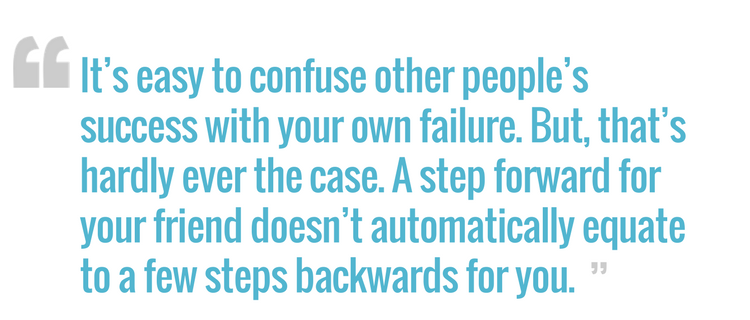
It’s easy to confuse other people’s success with your own failure. But, that’s hardly ever the case. A step forward for your friend doesn’t automatically equate to a few steps backwards for you.


Once you realize that someone else’s triumph isn’t their passive-aggressive attempt at poking holes in your own ego, it’s a whole lot easier to be happy for them.


2. Refresh Your Goals

While career comparison can be a nasty trap, there’s no denying that it can also provide the kick in the pants you need to refocus and continue making forward strides yourself.

For that reason, this is a great time for you to turn a discerning eye to your own career goals and figure out what you’d like to accomplish next.

Whether it’s something as small as revamping your personal website or something as momentous as making an entire career change, sit down and outline some of the things you’d like to achieve in the next six months or so. Don’t stop there—also jot down some specific action items you’ll need to make those things happen.

It might seem odd to use somebody else’s success as a stepping stone for your own career (even if they’re none the wiser!). But, take it from me, it works wonders. We might all hate to admit it, but we’re constantly matching ourselves up against the people around us—so, there’s really no better motivation.

Plus, knowing that you have your own plans and objectives in the works makes it that much less painful to celebrate your friend’s recent accomplishment.

3. Learn From Them

When we’re all so focused on competition, it becomes all too easy to forget the value of collaboration. But, if you neglect to take notes from the successes of your peers, you’re missing a great opportunity. Instead of resenting that person’s success, why don’t you learn from it?

Maybe that friend of yours just landed a new gig at an up-and-coming tech startup. Rather than feeling bitter about the fact that you’d like to do the same thing, why not ask her about the application process and what she did to stand out?

Or, rather than simply envying the person who scored a big raise, have a conversation with him about how that played out. Did he approach his boss? What sort of justification did he have in his back pocket to support his request?

Experience is a great teacher—and, that sentiment applies to the experiences of other people as well. So, don’t miss the chance to extract your own value and lessons from their achievements.

Not only will it push you forward, it’ll also give your friend a chance to further celebrate and discuss her own big milestone.


While we all like to think of ourselves as the eternally supportive and encouraging friends who cue up the marching band whenever our loved ones accomplish great things, that’s often not the case. As you already know all too well, your congratulatory feelings can easily be overshadowed by jealousy and resentment.

Ultimately, though, that gets you nowhere. Use these three tips to adequately honor and applaud other people’s big wins and you’ll not only be a better friend—but a better professional.

Source